Women in Technology: Amparo Alonso Betanzos
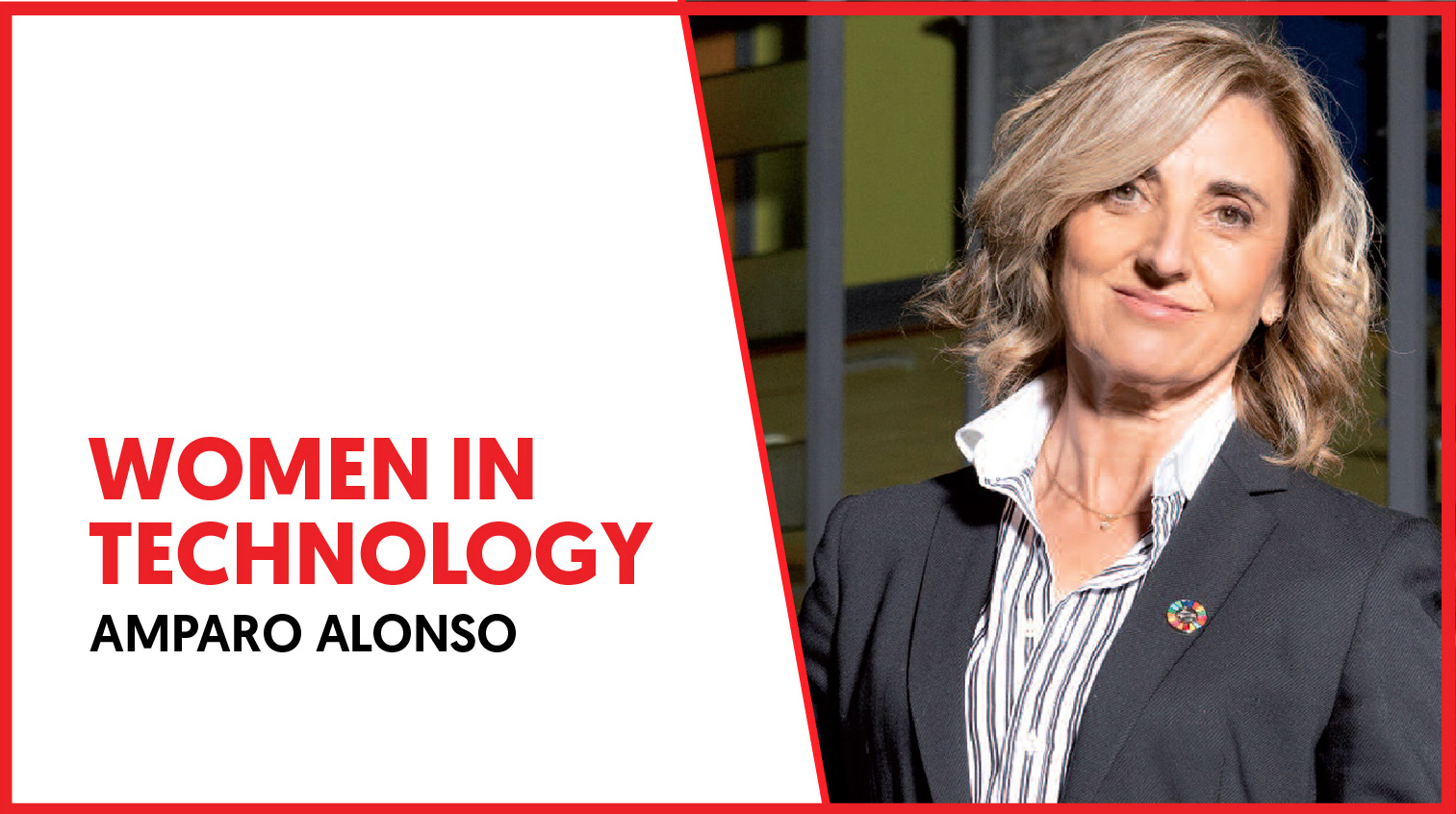
“The fact that she was my teacher and director of the final project has been an incentive for me to know that the path I had chosen at the age of 18 was the one I wanted to follow. Her work as a researcher, teacher and disseminator is an example for any women in technology”
There is no shortage of leading women in today’s technology scene, and we don’t have to go very far to find them. The technologist we are talking about today is one of the most influential voices in the field of Artificial Intelligence in Europe, and Araceli Goiriz says that she was her reference and mentor. She is Amparo Alonso Betanzos, chemical engineer, researcher and professor at the University of La Coruña in the Department of Computer Science. Born in Vigo, she is the president of the Spanish Association of Artificial Intelligence (AEPIA) and coordinator of the research group LIDIA (Artificial Intelligence R&D Laboratory) at the Faculty of Computer Science of the University of La Coruña (UDC).
Her experience as a pioneer in the field of Artificial Intelligence has led her to be a reference expert for the European Commission, as a member of the ‘Reserve List’ of the High Level Expert Group on Artificial Intelligence (AI HLG). She has been an advisor to the Spanish Executive for the drafting of the Spanish Strategy on Artificial Intelligence and is currently a member of the Artificial Intelligence Advisory Council of the Spanish Government. She has written or participated in 178 scientific articles to date. In his interviews, she promotes and disseminates the benefits of Artificial Intelligence in society and the need for an equal technological sector. She draws attention to the setback that is being experienced in this field.
Biographical notes
Born into a humble family, Amparo Alonso Betanzos (Vigo, 1961) graduated in Chemistry with a specialisation in Industrial Chemistry in 1984. Four years later, she obtained her PhD in Physics at the University of Santiago de Compostela with a work entitled ‘Fetus: expert system for the diagnosis, prognosis and therapy of foetal status’. She then continued her research career at the Medical College of Georgia at Augusta University (USA). It was there that she began her career as a researcher in Biomedical Engineering, where she focused on research into intelligent systems applied to clinical environments. Amparo Alonso Betanzos continued with antenatal monitoring. Later, with constant contact with medical staff, she managed to extend her research work to the ICU and pediatric units.
Legacy in the technology sector
Amparo has written more than 170 scientific articles in which she has contributed important solutions from an interdisciplinary perspective. She is an advocate of the use of Big Data that improves people’s quality of life and favours environmental sustainability. In this sense, projects such as “Scalable machine learning algorithms: Beyond classification and regression” and “LOCAW (Low-Carbon at Work: Modelling agents and organisations to achieve transition to a low-carbon Europe” stand out.
In some of these interdisciplinary projects she was able to simulate the effect of different environmental policies on the conservation of the environment. She argues that a change towards a greener world can be promoted from a field as apparently distant as computer science.
In his defence of Artificial Intelligence and Big Data, she warns that its use can be very beneficial because it can help people to make decisions based on volumes of data that we would otherwise not be able to handle.
Curiosities
Amparo is one of the top references and pioneers in Spain in the use of Artificial Intelligence applied to the social sciences. She is a technologist committed to the promotion of STEM careers among girls and young women and points out the setback that is being experienced in this regard. To this end, she provides some data, such as the fact that the percentage of female graduates in computer science has dropped from 30% to 12% since the career began. She points out that this is a problem of stereotypes that are promoted from childhood and in the media. As she explained in this interview, “the media is inculcating a series of aesthetic demands on girls”.
Amparo Alonso also mentions studies that say that even 9-year-old boys and girls associate engineering and computer science with masculine skills and abilities. She also points out that education is key to closing this gender gap. She did so at the award ceremony for the Maria Josefa Wonenburger prize, with which she was awarded in 2020 and with which the Xunta de Galicia recognises the relevant careers of women in the science and technology sectors. In her speech, she described the current situation of the under-representation of women in the technology sector as “a complex phenomenon that has to do with the education we give our sons and daughters, sometimes unintentionally, with the way we relate to society, with advertising, with the scant visualisation of women in science. You ask a boy or a girl which women scientists they know and they will know little more than Marie Curie”.
In order to disseminate and give visibility to the careers of other leading women in the field of technology, we are launching these articles in our blog. We encourage you to continue discovering the professional careers of other Women in Tecnology: